You Should Read This If:
- You’ve observed coworkers distract themselves and multi-task while you’re speaking
- Your meetings go over time
- Folks keep making slide decks have more slides than minutes in the meeting
- The pitches you’re making are soft
- Mentoring someone about their communication
- Your email updates don’t get any responses
Do your emails lack confidence? Have you caught yourself droning on in front of an executive? Does a coworker send you emails that have a TL;DR but even that is too long?
Want to just get to the point?
In the book Brief, the author Joseph McCormack lays out a compelling how-to manual grounded in today’s modern communication ecosystem. The classic, Elements of Style is great for what it is, but long-form writing isn’t how knowledge work is conducted these days. You need the skills to get your message across in today’s hectic digital world.
“A New Form of ADD”
Brief lays out a cute redefinition of the acronym “ADD” in each of its 3 main parts:
- Awareness - How to evaluate brevity in your work and others
- Discipline - Practice makes perfect, habit and muscle building for clarity
- Decisiveness - Mastery to utilize the skills for key moments

Executive Perspective
A strength of the book is that it nails down a target early: busy, interrupted executives. Until you’ve been in a high-level leadership role, it’s hard to convey how important getting to the point is. In any given day, an executive is dealing with 5-10 significantly different challenges. Just look at their calendar. Filled with staff management, strategy, clients, incidents, interviews, projects. Cal Newport has labeled this, the “hyperactive hive mind”. Modern knowledge work communication isn’t getting easier. Promises of tech that “AI will summarize all this for you” is a signal that folks are desperate to “get the point”.
Brief wants you to treat all of your communications as if they were intended for a busy executive, no matter their role. Get to the point, get to the point early.
Rambling Buries the Message
Your communications ought to be honed, focused and sharp as a razor’s edge. The words you vomit beyond what is required in a meeting blunt the edge of your message.
You can lose people within the first minute. This problem is only going to continue to get worse as the global attention span narrows by the day.
Show Don’t Tell
Chapter 9 lays out a compelling case of how and why visuals are so vital:
Which would you choose?
- Textbook of 500 pages of words or one with compelling graphs and diagrams
- A three-screen long email, or a 1 minute video that lays it out
- Slide with 10 bullet points, or an informative chart and 2 bullets of what the point is
Communicating with images is six times more effective than words alone
Visual Exercise
Let’s imagine you are going to implement a new process at work. This new process will involve several different departments at various points in the workflow. You have a choice:
- Make a pages-long legal-style document with parties, steps, substeps etc.
- Make an annotated flow chart that shows the interactions at various points
Studies routinely show that the visual option is by far the most effective way to get buy-in from your coworkers. Why? Because they can effortlessly put themselves spatially in the information you are providing them. Our brains are wired to be able to recall images and spatial layouts several orders of magnitude more than plain text.
Example: Try recalling the last flowchart someone showed you. I bet you can. Now try recalling the details of the last email you got that was a paragraph of text.
The Customer Perspective
Customers should be treated as the most executive of executives. They really don’t want their time wasted, and you cannot afford to be the source of that waste.
In the pitch room, customers inherently want their questions answered. They come to the meeting with questions about you, and your company. If you ask them for their questions upfront they’ll tell you. If in the first five minutes of opening your mouth you aren’t addressing those questions with firm answers, they will write you off. This is not a politician’s debate stage with double-speak and avoidance. Understand what they want and give it to them with undeniable clarity.
Tailor Your Message
Consider your audience. Every time. No matter if you’ve done it ten times, always consider who you are about to address. Tailor the message accordingly.
Interviewing
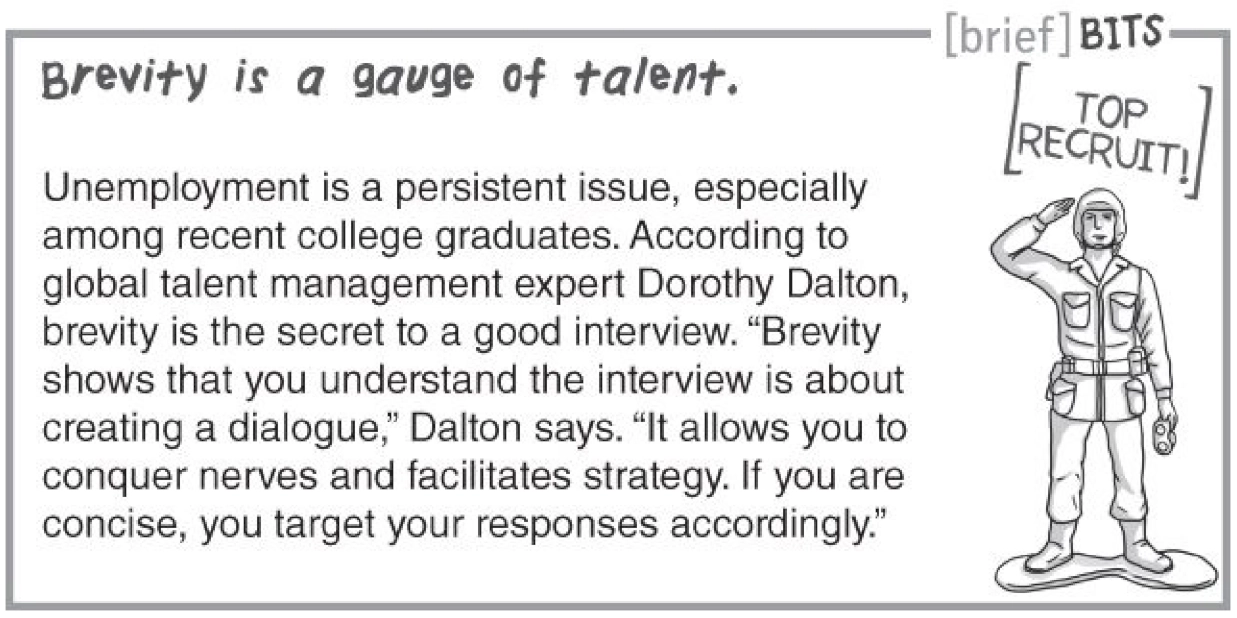
In Chapter 17, Brief lays out the importance of brevity when being interviewed.
An interview is a time for control, discipline, and awareness. Stay in the moment, and be in a conversation.
A nervous candidate will “fill” silence by just continuing to talk and talk way beyond answering the question and won’t arrive at a point. Strong candidates engage the topic, answer it and queue up the next one. Crisp back-and-forth are critical here, as the interviewer wants to be engaged.
This is a great example of the truths laid out throughout this book. You may be the most perfect fit for a role you are interviewing for, but if you can’t communicate properly, folks won’t know it.
Bad News
As a leader, you will deliver bad news. If the information you’re giving someone is tough to hear, don’t make it worse by dragging the point through the mud. Prepare, practice, and get to the point quickly. Knowing your audience is key here. Understand their concerns and questions, and hit them as quickly as you can.
… it’s important to be frank and positive without being patronizing.
Avoid overexplaining bad news because you think words will soften the blow. They won’t. It will only make it worse because the audience understands the bad news and you are only putting more layers of shit on top of it.
… you might be tempted to rehash your justifications for your decision, all they will hear is that they’re not good enough.
Mastery of brevity will arm you to minimize the moment with integrity and respect for the receiver.
Summary
Brief is an excellent resource that I regularly take off the shelf and thumb through to get a refresher on brevity. There are visuals scattered every few pages that create a compelling mental map of the lessons that stick with you long after you read it. I easily recommend Brief to folks I work with who struggle with brevity.
Enough Said.