What is the purpose of One-on-Ones?
It depends on whose path you are clearing! For direct reports, the goal is employee engagement and professional development. For your manager, it is strategic alignment and accurate reporting. Between peers, these meetings drive cross-functional collaboration. Regardless of the role, effective one-on-one meetings turn raw conversation into action items and measurable team productivity.
One-on-Ones With Your Directs
Give them the floor. Listen to what they say and what they don’t say. Your job is to clear the path so they can run. Build trust through a predictable rhythm. Stay action-oriented, don’t just fill the time, agree to mutual improvement plans.
One-on-Ones With Your Boss
Manage up with facts. Use your written notes to provide high-quality information. Consistent, predictable, and clear communication prevents surprises and makes reporting easy. Your boss doesn’t need more headaches, lighten their load by demonstrating that you are in control.
Clear asks for input and help from your boss are almost always welcomed. Believe it or not, they want to help, but aren’t mind readers, and love it when clear problems are shared with them.
One-on-Ones With Your Peers
Break down silos. Use this time to align goals and sync workflows. Trust between departments is built in private, 30 minutes at a time.
The more that you build an understanding of other folks’ perspectives on the problems your company faces, the more those folks will return in kind and want to support you.
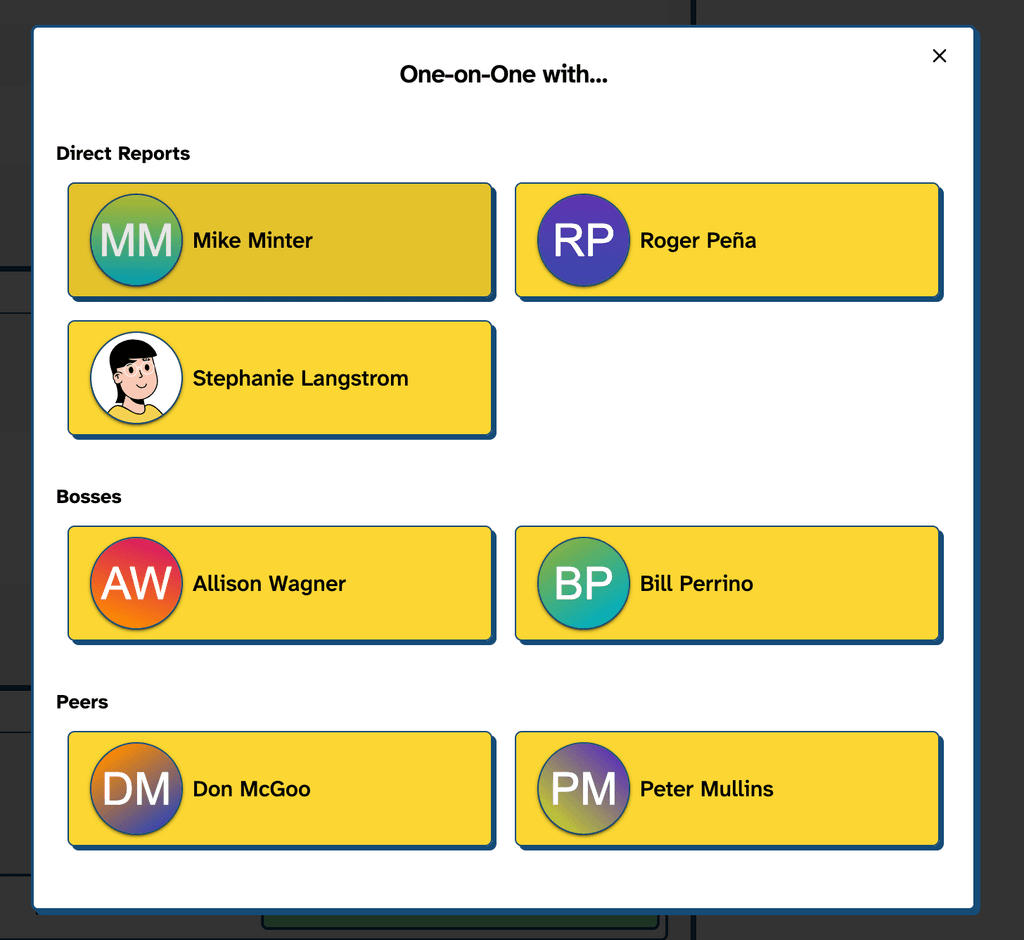
One-on-One Meeting Structure
How should you structure your one-on-one meetings? The data is overwhelmingly clear. The default structure that gives you the best results looks like:
- Scheduled, 30 minutes every week.
- The one-on-one is mostly for your direct. Skip small talk, let them lead.
- Start the same way, same question (even if it’s “alright, let’s have at it!” or “what’s going on in Bob-land?”). Don’t shy away from humor to your starting line, it can build a signal of humanity and trust. A consistent beginning to the meeting removes an element of unease.
- Use a consistent three-part template. See below.
Meeting Template
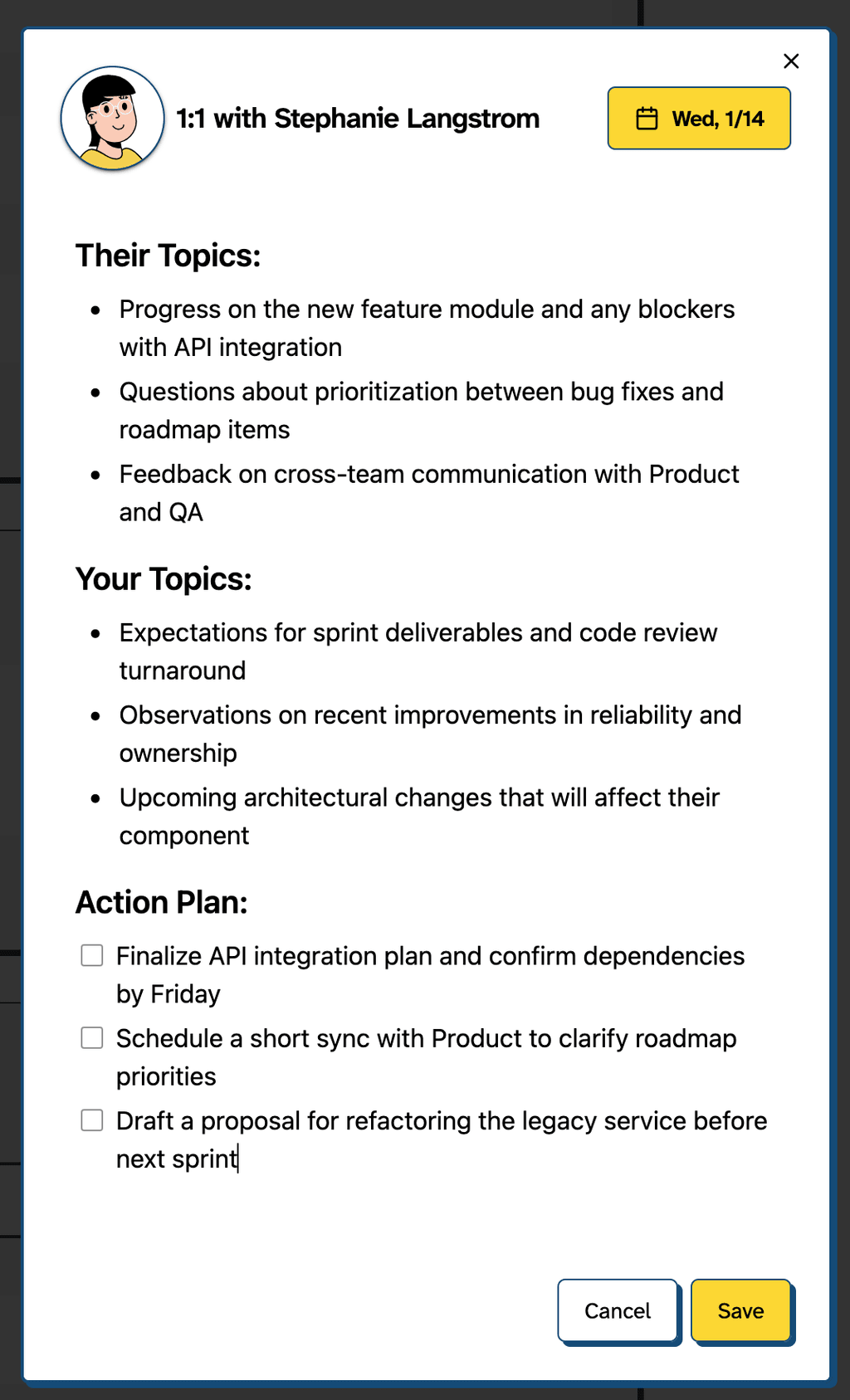
Solid one-on-one meetings should have a consistent 3 part agenda template: Their topics, your topics, the future. Your mileage may vary, but the more you stick to this proven formula, the more results you’ll get, and less time wasted in meetings.
Tip: If you can communicate topics to each other in advance, you’ll have a more comprehensive conversation. ClarityBoss gives you the tools to easily establish a 2-sided one-on-one meeting.
Their Topics
Let your direct reports take the lead, and always let them go first. It is your responsibility to understand the dynamics of your team, and it starts with the stories your direct reports tell you. When they bring up a topic, dig in until you understand the full picture. Don’t respond with curt affirmations; it is great to ask clarifying questions to signal interest.
If your direct report isn’t forthcoming with information, be patient and coach them. Ask prompting questions to understand their challenges. For example:
“I have some unscheduled time next week, is there anything I could do to help you out?”
“I get the feeling that the ___ project is unusually challenging, how have you found it?”
Avoid making your prompting questions self-serving. It will destroy the impression that you’re trying to help if you have selfish intentions.
Solicit their topics ahead of time. A great way to get your EQ (Emotional Quotient) primed and ready to handle a potentially tough conversation is to get your direct’s headline topics in advance, so you can be emotionally prepared or hunt down and bring some facts to light.
*Fair warning: If you get the headline of the topics, don’t assume too much. Give your direct the benefit of the doubt. You’d be surprised how many times they type one thing but mean another.*
Your Topics
This is your chance to be heard, set direction, implement changes, solicit input. Going second after your direct sets the tone of priority. You are here to help them, but now it’s your turn and you can now ask for things in return.
Don’t ambush your directs. You do not want your direct assuming that these one-on-one meetings are just so you can ambush them with hot takes and discomfort. Communicate in advance to let them warm up their emotions. If you do happen to strike a nerve, be quick to retreat to a conversational safe zone.
“I can tell this is irritating, that’s not my objective of these one-on-ones, so let’s table this and we can come back to it.”
If you are still in the trust-building phase of your relationship, stop here. Verbally acknowledge that in a future one-on-one that you intend to talk about future asks, but not yet. You might be surprised how often your direct will ask to short to get started anyway.
The Future
After you’ve done 4-5 one-on-ones (or your direct is prompting you) you’ve built trust capital and you can start to bring future discussion into the mix.
Because one-on-ones are recurring, there will be a “next one” to anticipate. Set the tone that both parties are going to take action by the next time you talk (usually a week from now). Be firm in your expectations of them, and clear about their expectations of you. The goal is that both of you walk away optimistic that each other will execute against the commitments discussed.
Ask for more. One-on-ones are a great opportunity for you to coach your direct into a higher level of performance. Because you started with their topics (establishing trust), your topics (showing them your world) you have created a baseline in which it’s okay to push your direct and ask for more. You’ve earned it.
Share One-on-Ones
After your one-on-one, it is important to share the information. Do it immediately to nip confusion in the bud. Record action items in a consistent place so they happen. A shared record is the only way to stay aligned. Silence creates doubt; clarity builds trust.
ClarityBoss provides shared one-on-one notes and action items that you can reference in your next one-on-one or future performance reviews.
For more information about one-on-ones, check out our book review for The Effective Manager below!